Difference between String Inverters, Microinverters, and Optimizers: Which to Choose?
Understand the difference between string inverters, microinverters, and power optimizers, and discover which is the best option for your solar system.
EQUIPAMENTOSTECNOLOGIA SOLAR
Vinicius Pena
4 min read
Difference between String Inverters, Microinverters, and Optimizers: Which to Choose for Your Solar System?
Published in 01/06/2026
If you've started researching solar energy, you've probably already realized that it's not enough to just choose solar panels. One of the most important components—and one that generates a lot of questions—is the solar inverter.
And then the classic questions arise:
String inverter or microinverter?
What are power optimizers?
What is the best option for my house?
The truth is that there is no single choice that works for all projects. Each technology has advantages, limitations, and ideal applications. In this article, you will understand in a simple and practical way how each type of inverter works and which one makes the most sense for your photovoltaic system.
Solar panels generate direct current (DC) energy. The problem is that your home, your business, and the electrical grid use alternating current (AC).
That's where the solar inverter comes in.
In short, the inverter is the "brain" of the photovoltaic system. It is responsible for:
Convert the energy generated by the panels (DC) into usable energy (AC).
Ensure that the power supply is at the correct voltage and frequency.
Monitor system output.
Protecting the system against electrical faults
In other words, without an inverter, solar energy simply doesn't work.
Now that you know its importance, let's understand the main types available on the market.
What is a solar inverter and why is it so important?
String inverter: how does it work?
What is a string inverter?
The string inverter is the most traditional model and also the most widely used in Brazil.
In this system, the solar panels are connected in series, forming one or more "strings" (chains). All the energy generated by these panels is sent to a single central inverter, usually installed on the wall or near the electrical panel.
Advantages of the string inverter
The string inverter stands out primarily for:
More affordable cost compared to other solutions.
Established and widely used technology
Simple maintenance
Good efficiency on roofs without shade.
Ideal for simple residential and commercial projects.
Therefore, it is usually the standard choice when the roof has good sun exposure and few obstructions.
Disadvantages of the string inverter
Despite the advantages, there are some points to consider:
If one panel has shading, dirt, or defects, the entire string may lose efficiency.
Monitoring is usually done by a set of license plates, not individually.
Less flexibility for future expansion of the system.
When is a string inverter the best choice?
A string inverter is ideal when:
The roof receives even sunlight throughout the day.
There are no shadows from trees, walls, or buildings.
The project is simple and straightforward.
The budget is more limited.
Microinverter: how does it work?
What is a microinverter?
Unlike string inverters, microinverters are installed directly on each solar panel (or on small groups of panels).
This means that each board works independently, converting DC power to AC individually.
Advantages of microinverters
Microinverters are gaining ground precisely because they solve some common problems of traditional systems:
Each panel operates independently.
Shadows on one sign do not affect the others.
Individual monitoring of each panel.
Greater flexibility for system expansion.
Greater electrical safety
Disadvantages of microinverters
On the other hand, there are some disadvantages:
Higher initial cost
More detailed installation
Maintenance can be more laborious (the equipment is on the roof).
When is a microinverter most worthwhile?
Microinverters are highly recommended when:
The roof suffers from partial shading.
The signs are at different angles or orientations.
Consumers want detailed monitoring.
There are plans for future expansion of the system.
What are power optimizers?
How do optimizers work?
Power optimizers are devices installed on each solar panel, but—unlike microinverters—they do not convert the energy to alternating current.
The conversion continues to be performed by a central (string) inverter, while the optimizers:
They adjust the individual performance of each panel.
They reduce losses caused by shade or dirt.
They allow monitoring by license plate.
Difference between a microinverter and an optimizer.
The main difference is:
Microinverter: converts DC to AC on the panel itself.
Optimizer: improves panel efficiency, but conversion remains central.
When should you use optimizers?
Optimizers are recommended when:
There is partial shading.
The project requires individual monitoring.
Consumers want more efficiency, but without the total cost of microinverters.
Direct comparison: String Inverter vs. Microinverter vs. Optimizers
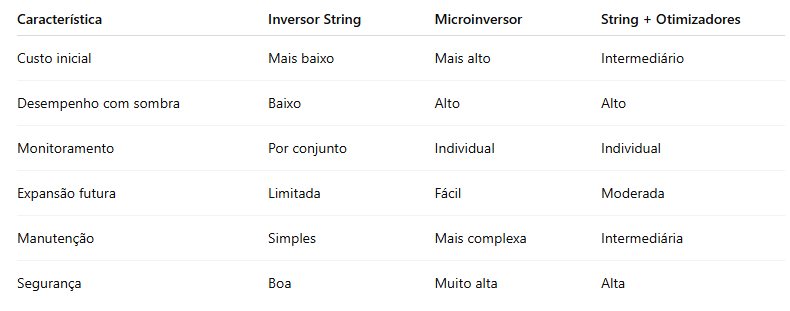
Which inverter is best for you?
The ideal choice depends on your project, not just the price.
Small houses and simple roofs: string inverter
Roofs with shade or different orientations: microinverter
Seeking efficiency and balanced cost: string with optimizers
Who wants to monitor each panel: microinverters or optimizers?
The most important thing is to conduct a personalized technical analysis before making a decision.
Common mistakes when choosing a solar inverter.
Some mistakes are very common and can be costly in the long run:
Choosing solely based on the lowest price
Ignore the roof shading.
Not thinking about future expansions.
Disregard warranty and technical support.
Failure to assess the type of monitoring offered.
Avoiding these mistakes ensures greater efficiency and financial return over the years.
Conclusion
Now you know that there is no single "best" inverter. There is only the most suitable inverter for each type of project.
String inverters remain an excellent option for many applications. Microinverters and optimizers, on the other hand, offer modern solutions for more complex situations, especially when there is shading or a need for individual control.
If you're thinking about investing in solar energy, understanding these differences is crucial for making an informed choice and avoiding headaches in the future.
Partner
For those looking to install solar energy safely and with specialized technical support, we recommend A.L. Pena Energia Solar, a company that operates in the photovoltaic sector offering customized projects for homes, businesses, and rural properties.
Telephone
+55 16 99648-9008
© 2025. All rights reserved.